

Starting a thesis can feel like standing at the foot of a massive mountain. One day you are simply an undergraduate student attending lectures, and the next, you are expected to produce a massive piece of original research. It is a completely different style of academic writing that requires you to be part project manager, part detective, and part writer.
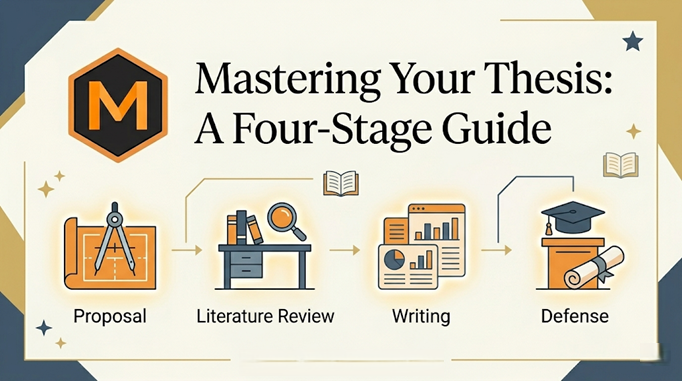
The transition from regular coursework to independent research catches most students off guard. Instead of answering prompts provided by a professor, you are now responsible for generating your own questions, finding data, and defending your conclusions. To make this process manageable, it helps to view your thesis not as one giant, terrifying task, but as a journey divided into four distinct, sequential steps.
Stage 1: The Research Proposal
The first step of your thesis journey is the research proposal. Think of this document as your architectural blueprint. Before you can build a house, you need to show the city planners that your design is safe and structurally sound. Similarly, before you spend months writing, your university committee needs to approve your research plan. A good proposal clearly outlines what you intend to study, why it matters, and how you plan to gather your information.
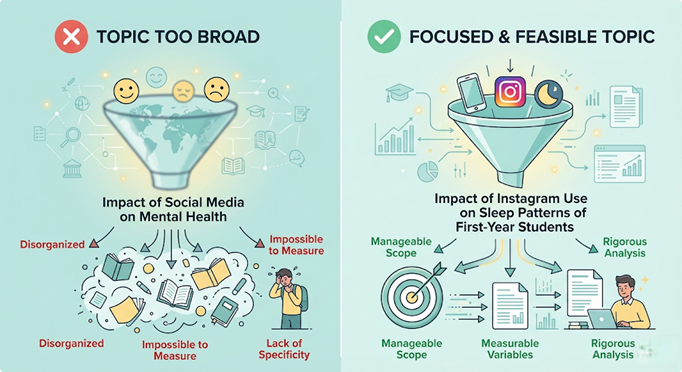
The biggest trap undergraduate students fall into during this stage is choosing a topic that is far too broad. For instance, trying to study “the impact of social media on mental health” is a recipe for disaster because the scope is simply too vast for a single paper. Instead, you need to narrow your focus to something specific, like “the impact of Instagram usage on the sleep patterns of first-year undergraduate students.” Navigating these early structural choices can be incredibly difficult, and getting early guidance is critical. Seeking professional help with thesis structure during this formulation phase can save you from having to restart your entire project three months down the line.
Stage 2: The Literature Review
Once your proposal is approved, you enter the literature review stage. This is where you become a detective. Your goal is to read everything relevant that has already been published about your topic. A common misconception among students is that a literature review is just a summary of different books and articles. In reality, it is a critical synthesis. You are trying to paint a picture of the current academic conversation and, most importantly, identify the “gap” that your research will fill.
To keep your reading organized, it is highly recommended to use a synthesis matrix. This prevents you from getting lost in hundreds of pages of academic jargon.
Sample Literature Synthesis Matrix
| Source | Core Methodology | Key Findings | Identified Limitations / Gaps |
| Smith & Jones (2022) | Quantitative survey of 200 participants | High screen time correlates with delayed sleep onset. | Did not account for the specific types of media apps used. |
| ** Patel (2024)** | Qualitative interviews (sample size: 15) | Students use social media as a coping mechanism for academic stress. | Small sample size; findings cannot be widely generalized. |
| Your Target Project | Mixed-methods approach | Combines app tracking with qualitative sleep diaries. | Bridges the gap between self-reported data and objective usage. |
Stage 3: Data Collection, Analysis, and Writing
With your literature review complete, you move into the core execution phase: gathering your data and writing the paper. Whether you are conducting laboratory experiments, issuing digital surveys, or analyzing historical texts, this stage requires immense discipline. You must document your methodology so clearly that another researcher could read your paper and replicate your exact process.
Once the data is in, the actual writing begins. This is where academic burnout peaks. Between balancing final-year exams, part-time jobs, and formatting rules like APA or Harvard, the sheer volume of work can cause severe writer’s block. When the academic workload becomes completely unmanageable, many students realize they need reliable, direct assistance to cross the finish line. If you find yourself completely stuck or running out of time, turning to a trusted expert team by MyAssignmentHelp to write my thesis paper for me ensures that your arguments are organized logically and meet strict institutional standards while keeping your sanity intact.
Once your draft is on paper, the process transitions into heavy editing. You need to verify that your data directly supports your conclusions and that your academic tone remains objective and balanced throughout every single chapter.
Stage 4: The Thesis Defense (Sharing Your Findings)
The final stage of the journey is the thesis defense. For many undergraduates, this sounds like an interrogation, but it shouldn’t feel that way. In reality, the defense is an academic conversation. You have spent months becoming an expert on your specific niche topic. The professors on your committee aren’t trying to trick you; they want to see if you truly understand the choices you made during your research.
A successful defense relies on preparation rather than memorization. You should be ready to present a concise 10-to-15-minute summary of your work, focusing heavily on your findings and what they mean for the wider field of study. After your presentation, the committee will ask questions about your methodology, your sample size, or alternative explanations for your data. Approach these questions with confidence—admitting a limitation in your study isn’t a sign of weakness; it is a sign of a mature, honest researcher.
Final Checklist for Undergraduate Researchers
To ensure your thesis stands out and passes academic scrutiny easily, keep these four essential tips in mind as you work through each stage:
- Start an annotated bibliography early: Write down a three-sentence summary of every paper you read the day you read it. You will thank yourself later.
- Backup your data in three places: Use cloud storage, an external drive, and email drafts. Computer crashes do not care about university deadlines.
- Write the introduction last: It is much easier to introduce a journey once you already know exactly where you ended up.
- Lean on your advisor: Your assigned professor is there to guide you. Send them bullet points of your progress every two weeks to stay aligned.
Frequently Asked Questions (FAQ)
Q.1 What is the average length of an undergraduate thesis?
Ans: For most undergraduate programs globally, a bachelor’s thesis ranges between 8,000 and 12,000 words. However, this varies significantly depending on whether your field is qualitative (like history or literature) or quantitative (like engineering or physics). Always check your department’s handbook for exact requirements.
Q.2 How do I find a genuine gap in existing literature?
Ans: Look closely at the “Limitations” or “Future Research” sections at the very end of recently published journal articles. Authors explicitly state what they didn’t have the time or resources to study. This is the easiest way to find an open door for your own research project.
Q.3 What happens if my research data disproves my original hypothesis?
Ans: This is completely fine! In real science and academia, proving a hypothesis wrong is just as valuable as proving it right because it prevents future researchers from going down the wrong path. Present your data honestly, discuss why the results turned out differently than expected, and analyze those unexpected factors in your discussion section.
About The Author
Hi, I’m John Martin, a senior academic consultant and research strategist at MyAssignmentHelp. With over a decade of experience guiding undergraduate and postgraduate students through the rigors of advanced academic writing, I specialize in breaking down complex research methodologies and thesis frameworks into manageable, actionable steps.
Turning Your Topics | Multiple Stories Into Engaging Content
